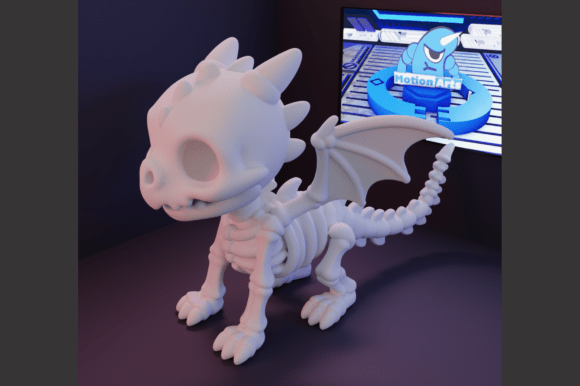
Dragon Skeleton: A Practical Guide to Printing Fantasy Realism
The allure of a dragon skeleton lies in its ability to bridge the gap between biological realism and high fantasy. For 3D printing enthusiasts, collectors, and tabletop gamers, this specific STL file represents more than just a decorative object; it is a test of printer calibration, material choice, and post-processing skill. When executed correctly, a dragon skeleton serves as a centerpiece for dioramas, an educational anatomical study, or a premium collectible. However, the intricate nature of bone structures often leads to frustration for those who approach the print without a strategic plan. Understanding the nuances of this model before you hit "print" is the difference between a shelf-worthy legend and a bin full of failed layers.
Evaluating Mesh Integrity Before Slicing
One of the most frequent oversights when downloading any complex creature STL is assuming the file is print-ready. Dragon skeletons are geometrically demanding, featuring thin ribs, delicate vertebrae, and complex cranial structures. A common mistake is failing to run a mesh repair analysis before slicing. Non-manifold edges or inverted normals might not be visible in the preview but will cause catastrophic failures mid-print, especially on resin printers where suction forces can tear delicate geometry from the build plate.
Rather than risking hours of wasted time, always validate your dragon skeleton file using tools like Microsoft 3D Builder, Blender, or your slicer’s built-in repair function. Pay special attention to the connection points between the ribcage and the spine. In many fantasy models, these areas are stylized rather than anatomically fused, creating weak points that snap during support removal. If you identify thin sections under 0.8mm for FDM or 0.3mm for resin, consider scaling the model up slightly or reinforcing these joints digitally. This proactive step ensures structural integrity without compromising the aesthetic flow of the creature.
Material Selection Beyond Standard PLA
While standard PLA is the default for many hobbyists, it is rarely the optimal choice for a dragon skeleton intended for display or handling. The primary issue is layer adhesion and brittleness. Bone-colored PLA can look chalky and artificial, and the layer lines often distract from the organic texture of the sculpt. Furthermore, if this piece is destined for an RPG setting where it might be handled by players, standard PLA is prone to snapping at stress points.
Consider upgrading to PLA+ or PETG for FDM printing. These materials offer better layer bonding and a slight flexibility that mimics the tensile strength of real bone. For resin users, avoid standard grey or white resins which remain brittle indefinitely. Instead, opt for ABS-like or tough resins specifically formulated for detailed miniatures and props. These formulations cure with enough durability to withstand support removal and cleaning without shattering. If you aim for museum-quality realism, matte-finish resins are superior to glossy ones, as they absorb light similarly to porous bone rather than reflecting it like plastic.
Strategic Orientation and Support Management
The orientation of a dragon skeleton on the build plate dictates both the visual quality and the success rate of the print. Beginners often orient the model flat to maximize bed adhesion, but this places layer lines directly across the curvature of the ribs and skull, ruining the illusion of smooth bone. Conversely, printing vertically to hide layer lines can create massive overhangs that require aggressive supports, leading to scarring and cleanup nightmares.
The corrective approach involves angling the model. Tilting the dragon skeleton at 30 to 45 degrees usually offers the best compromise. This angle allows the ribs to print with smoother surface transitions while keeping the center of gravity low enough to prevent warping. When placing supports, avoid auto-generation settings. Manual support placement is mandatory for anatomical models. Place supports inside the rib cage and under the jawline rather than on visible outer surfaces. Use lighter contact points or "tree" supports to minimize surface damage. Remember that every support mark requires sanding later; investing ten minutes in manual support placement saves hours of finishing work.
Avoiding the Uncanny Valley in Post-Processing
A pristine print is only half the battle. Many creators undermine their dragon skeleton by applying paint directly to the raw print or using pure white acrylics. This results in a toy-like appearance that lacks depth. Real bone is not monochromatic; it has undertones of yellow, brown, and grey, with varying degrees of translucency depending on thickness.
To achieve a realistic finish, start with a proper primer. A grey or off-white primer provides a neutral base that helps subsequent colors pop. Avoid spraying heavy coats that fill in the fine details of the vertebrae or teeth. Instead, use multiple thin layers. When painting, employ a wash technique first. A sepia or brown wash settles into the crevices and pores of the model, instantly creating artificial shadows and age. Follow this with dry brushing using bone white or ivory to highlight the raised textures. Finally, seal the model with a matte varnish. Glossy finishes destroy the illusion of bone unless you are specifically replicating wet or polished specimens. This layered approach transforms a plastic print into a believable artifact.
Scaling Considerations for Functionality
Context matters significantly when choosing the size of your dragon skeleton STL. A frequent error is printing at 100% scale without considering the end use. A model designed for digital viewing may have details that are too small for FDM printing at miniature scales, or conversely, wall thicknesses that are unnecessarily bulky for large-scale displays.
If you are creating terrain for D&D or Warhammer, verify the scale against existing miniatures before printing. A dragon skeleton meant to be a battlefield prop should match the footprint of other creatures in your collection. For home decor or cosplay props, measure your available space and budget for filament or resin. Scaling up increases material usage exponentially, not linearly. A 200% scale dragon uses roughly eight times the material of the original. Always calculate costs and print times based on the scaled volume, not the base file stats. Additionally, check if the STL author provided pre-supported versions or hollowed variants for larger scales, as solid large prints are wasteful and prone to thermal warping.
Licensing and Commercial Viability
For entrepreneurs and small business owners looking to sell physical prints of a dragon skeleton, ignoring licensing terms is a critical risk. Just because an STL is downloadable does not mean it is cleared for commercial sale. Many designers offer personal-use-only files for free or low cost, requiring a separate subscription (such as Patreon or Tribes) for merchant licenses.
Before listing any dragon skeleton prints on Etsy, Shopify, or at conventions, read the license file included in the download or check the product page explicitly. Selling unlicensed prints can lead to DMCA takedowns, account bans, and legal issues. Furthermore, respect the designer's attribution requirements. Properly crediting the digital artist not only keeps you compliant but also builds trust with customers who value ethical sourcing in the maker community. If you modify the model significantly, clarify whether the license permits derivative works. Transparency here protects your business reputation and supports the ecosystem that creates these incredible assets.