Synthwave Laser Beams Background: Retro Visual Assets
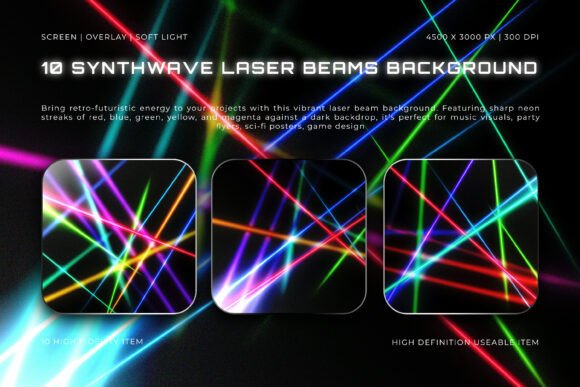
Retro-futuristic aesthetics have moved beyond niche internet subcultures to become a staple in modern commercial design. The Synthwave Laser Beams Background pack capitalizes on this enduring trend by providing high-resolution assets that bridge the gap between 1980s nostalgia and contemporary digital clarity. Unlike generic neon textures that often suffer from compression artifacts or low resolution, these designs are engineered for professional application. Featuring sharp streaks of red, blue, green, yellow, and magenta against a deep dark backdrop, they serve as versatile foundations for creators who need immediate visual impact without sacrificing technical quality.
The utility of this collection lies in its specificity. Synthwave is not merely about bright colors; it is about the interplay of light against darkness, evoking a sense of speed, technology, and nocturnal energy. These backgrounds capture that atmosphere with precision. At 4500 × 3000 pixels and 300 DPI, they meet the rigorous demands of both large-format printing and high-definition digital displays. Whether you are designing a concert poster, a streaming overlay, or a product advertisement, the file specifications ensure that the neon gradients remain smooth and the laser edges stay crisp, avoiding the pixelation that often plagues retro-themed graphics.
Technical Integration and Blending Modes
The true power of the Synthwave Laser Beams Background assets emerges during post-production. Because these images feature high-contrast lighting on a near-black background, they are specifically optimized for non-destructive editing workflows. Designers should utilize blending modes such as Screen, Overlay, or Linear Dodge (Add) to integrate these beams into existing compositions. When set to Screen mode, the dark backdrop becomes transparent, allowing only the luminous laser streaks to interact with the underlying layers. This technique preserves the original artwork while adding a dynamic lighting effect that would be time-consuming to render manually.
For print designers, the 300 DPI resolution is critical. Neon effects can easily look muddy or banded when printed if the source file lacks sufficient data. These JPG files retain enough color information to produce vibrant physical outputs, from business cards to venue banners. The inclusion of ten distinct variations allows for consistent branding across multiple touchpoints. You might use a magenta-dominant beam for social media headers and a blue-green variation for event tickets, maintaining a cohesive visual identity while keeping individual pieces fresh. This systematic approach to asset usage saves time and ensures professional consistency across campaigns.
Applications in Music and Event Marketing
Musicians and event promoters are perhaps the most frequent users of synthwave imagery, but effective application requires more than slapping a neon background behind an album title. The laser beams in this pack function best as directional cues. In flyer design, align the angle of the laser streaks with your typography or the gaze of a subject to guide the viewer’s eye toward essential information like dates, venues, or call-to-action buttons. The vibrant colors naturally attract attention, so using them strategically prevents visual clutter and enhances readability rather than competing with it.
For video content creators and VJs, these static backgrounds serve as excellent base layers for motion graphics. By applying subtle displacement maps or turbulence effects in software like After Effects or Resolume, the static lasers can be animated to pulse in time with audio. The high resolution provides ample headroom for zooming and panning without losing quality. This makes the Synthwave Laser Beams Background pack a cost-effective alternative to purchasing expensive stock video footage. A single high-quality still image, when manipulated correctly, can generate minutes of unique, reactive visuals for live performances or YouTube intros.
Elevating Game Design and UI Interfaces
Indie game developers and UI designers can leverage these assets to establish mood without overwhelming gameplay. In user interface design, subtlety is paramount. Consider using the laser beams at reduced opacity as border accents or background elements for menu screens. The dark negative space in these images is just as valuable as the bright beams; it provides necessary breathing room for text and interactive elements. When designing HUDs or inventory screens, the neon streaks can reinforce the sci-fi theme while the dark areas maintain contrast ratios required for accessibility and legibility.
Environment artists can also repurpose these 2D assets for 3D projects. Projecting these high-resolution textures onto geometry within a game engine can create convincing holographic billboards, force fields, or atmospheric volumetric lighting effects. This technique, known as texture baking or projection mapping, allows for complex visual fidelity with minimal performance overhead. Instead of calculating real-time ray-traced neon lights, which can be taxing on hardware, developers can use these pre-rendered beams to fake the effect convincingly. This practical application demonstrates how 2D asset packs can solve 3D optimization challenges in game development pipelines.
Adapting Retro Aesthetics for Corporate and Editorial Use
While synthwave is inherently stylized, it can be adapted for more formal or editorial contexts with careful adjustment. Marketers targeting Gen Z and Millennials often find that retro-futurism resonates as a symbol of innovation and optimism. To adapt the Synthwave Laser Beams Background for corporate presentations or tech blogs, consider desaturating the colors slightly or shifting the hue toward cooler blues and cyans. This tones down the "party" association while retaining the technological connotation. Pairing these modified backgrounds with clean, sans-serif typography and ample whitespace creates a sophisticated hybrid aesthetic that feels current rather than costumey.
Educators and content creators focusing on technology, coding, or digital history can use these visuals to create engaging slide decks or thumbnails. The key is relevance; the imagery should support the narrative of digital evolution or cybernetics. Avoid using neon beams purely for decoration. Instead, let the direction of the light imply progress, connection, or data flow. When the visual metaphor aligns with the educational content, the aesthetic enhances retention and engagement. This thoughtful application distinguishes professional creative work from superficial trend-chasing, ensuring the design serves a functional purpose beyond mere nostalgia.
Best Practices for File Management and Workflow
Maintaining an organized asset library is essential for efficient creative work. Since this pack includes ten distinct JPG files, establish a clear naming convention upon download. Tagging files with descriptors like "vertical-magenta," "horizontal-blue," or "diagonal-multi" allows for rapid retrieval during tight deadlines. While JPG is a universally compatible format suitable for final output and quick mockups, designers working in layered environments should consider converting these files to smart objects or embedding them in PSD/AI templates. This protects the original pixel data from degradation during repeated scaling and transformation.
Color management is another practical consideration. Neon colors on screen often fall outside the CMYK gamut printable on standard paper. Before sending designs featuring these Synthwave Laser Beams Backgrounds to print, always perform a soft proof or convert the color profile to the specific CMYK standard requested by your printer. Some vibrancy loss is inevitable, but proactive color correction can preserve the intended glow. Adjusting curves and saturation after conversion often yields better results than relying on automatic conversion. Understanding these technical limitations ensures that the electrifying energy seen on your monitor translates effectively to the final physical product, maintaining the integrity of your creative vision across all mediums.